

Copenhagen, Denmark
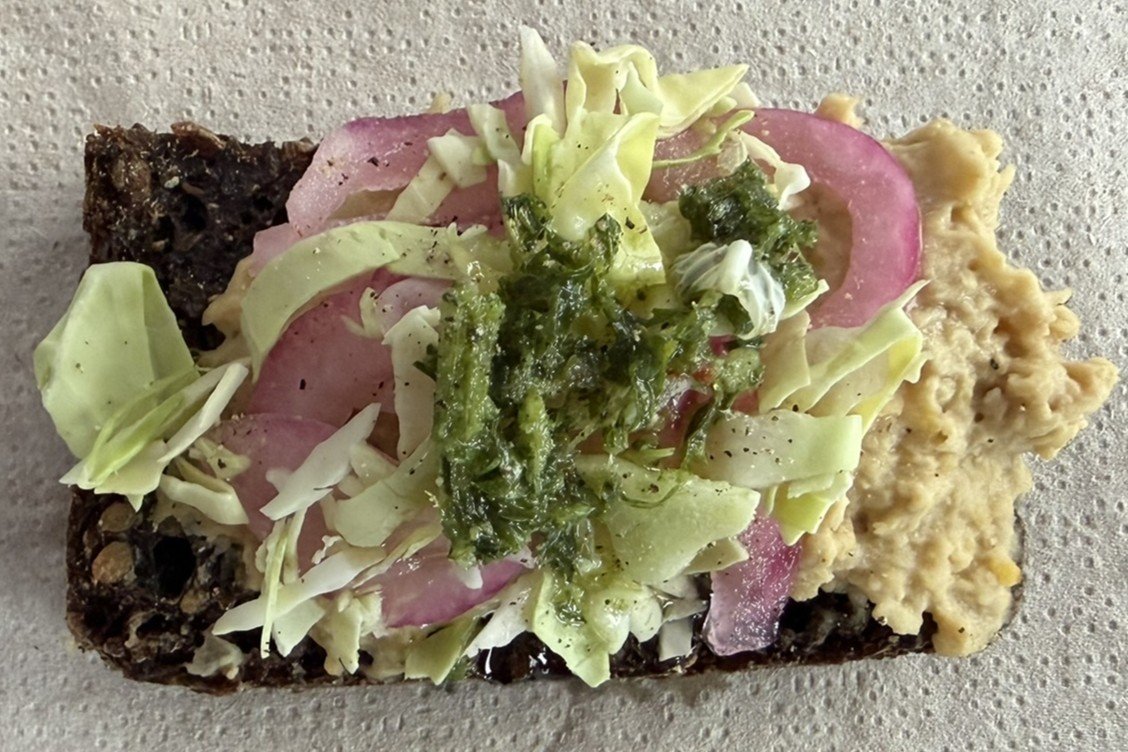
Smorrebrod with hummus, picked onion, cabbage and spinache
I love trying new foods, partly for novelty, but also in the search for a new favorite. Good food is one of those transcendent things in life. So, I often book tours to sample local cuisine when I travel to new countries.
For my first-ever visit to Denmark, I am touring a food market in Copenhagen, the Torvehallerne. At one stop, our guide brings platters covered in “hors d’oevres” arranged in neat lines, reminiscent of Crostini with fig jam, onions and whipped feta or bruschetta, but too large for one bite. Smorrebrod, the guide explains, is a traditional Danish dish featuring a thick toasted bread, like rye, under piles of toppings. Reportedly, working Danes long ago heaped cheap, available ingredients and leftovers on top of their stale bread, making an affordable, filling meal, ingredients like pickled herring with red onion and dill.
As I’m listening, my mind drifts to my childhood, being force-fed Creamed Tuna on Toast, and I’m getting a little anxious thinking of the slop I'll have to shovel down as politely as possible for international diplomacy’s sake. For those who haven’t had the experience, American sandwich bread disintegrates like cotton candy, turning even a good bechamel into a tuna flavored goop. Fortunately, this particular preparation was splendid, the hardy bread still substantive but imbued with flavors from the toppings, sour pickled onion, garlic, sesame oil, pepper. But something else about this dish whetted my curiosity. This Smorrebrod had hummus, a mediterranean food on what I thought was a traditional Danish dish. Why?
My first instinct might be to look at immigration patterns. Since the late 1970s thousands of peoples from MENAP countries and Turkey immigrated to Denmark, according to the Danish Ministry of Immigration and Integration, bringing flavors and foods from home, which find their way into Danish cooking over time, just as the same immigrants begin eating Danish cuisine. Such acculturation is a tale as old as time, apparently explaining (with a colonial twist) why today Tea-time is British, Hamburgers are American, and Marinara is Italian. Faced with such scary changes, I imagined one might stand tall and shout, “Tradition! Tradition!” as Tevye did.
In the end, I realized I really have no fucking clue, and as scary as it is to admit ignorance, it’s worse to defend ignorance (or stupidity) with certainty. So, I decided to investigate further, and it turns out that food is really really complicated. Eating is a deeply personal, purely subjective experience, informed not only by our individual tastes, but also individual history and identities, identities cultural, religious, racial, gender, socio-economic and political, all set against an overall trend toward corporatization and globalization. Taking one of my childhood dinners as an example, canned tuna surges in popularity in the post-WWII boom, like many other processed foods. Corporations make tuna farming and canning cheap and easy. So, Creamed-Tuna on Toast becomes a quick, affordable dish for America’s burgeoning, middle class, which is then passed to subsequent generations (me) by a combination of practicality and nostalgia. Now that I’m older, my partner and I have unsuccessfully experimented in making it more palatable. So, it has changed over the years in my home, but still basically a 1950s American dish. I never realized that Creamed-Tuna could mean so much. But, I do know lots of foods which I know peg me for an American (ice, peanut butter, hot dogs, sugar, coffee creamer, etc.) just as there are foods I once avoided, which pegged me for a Mormon (coffee, tea, alcohol, nicotine).
This story of identity complicates further because everyone shares in the eating experience, every day, making food a vehicle for communication and relationship, but also for artistic and political expression. My first date with my partner was at a Thai restaurant, a shared experience. In a post about Kanab, Utah, I alluded to an animal sanctuary which serves vegan lunches, presumably not because meat tastes bad but because they morally object to the commodification and exploitation of animals. In America, one can find Thanksgiving recipes that feature indigenous foods, and seemingly every Football Sunday the American Beef Council reminds us, “Beef. It’s what’s for dinner.” It’s all so, relational, societal, even political. What would be so bad about a nice bowl of tofu for the Cowboys game?
So, what am I to make of all this? It all seems very complicated, and I can’t know why that particular preparation featured hummus, at least without more expertise and a research grant. Its presence could represent simple cost-cutting measures for the restaurant, an attempt to target hummus-loving American tourists, or a political statement about accepting MENAP and Turkish immigrants into Danish society, or any combination thereof. But in the end, perhaps we just need to be conscientious, cautious, and empathetic. I continually come back not to a new idea or perspective but to confirmation of an old one, seemingly still unlearned, as told brilliantly by The Fiddler on the Roof.
A fiddler on the roof. Sounds crazy, no? But here, in our little village of Anatevka you might say every one of us is a fiddler on the roof trying to scratch out a pleasant, simple tune without breaking his neck. It isn't easy. You may ask, 'Why do we stay up there if it's so dangerous?' Well, we stay because Anatevka is our home. And how do we keep our balance? That I can tell you in one word: tradition!"
Because of our traditions, we’ve kept our balance for many, many years. Here in Anatevka we have traditions for everything how to eat, how to sleep, how to wear clothes. For instance, we always keep our heads covered and always wear a little prayer shawl. This shows our constant devotion to God. You may ask how did this tradition start? I'll tell you — I don't know. But it's a tradition. Because of our traditions, everyone knows who he is and what God expects him to do.
Tevye’s three daughters and nation each challenge his traditional notions in their own way, ending with his second daughter travelling to Siberia, a rift between himself and his third daughter, and the expulsion of all Jews. Tevya’s story reminds me both of humanities worst atrocities when outside people persecute a “strange” people, and of humanities worst atrocities when a community persecutes one of its own who fails to conform to increasingly arbitrary and meaningless traditions. As much as we cling to the familiar to solidify our identity we also need exposure to understand how important those traditions are.
So we are all, each scratching out our own simple tunes.
Sources
If you are interested in reading more about immigration in Denmark, food issues in Denmark, or Food Anthropology generally, check out my sources below.
Fiddler on the Roof - Fiddler on the Roof (1971) - IMDb
Immigration in Denmark - Ministry Rapport, Immigrants and their descendants - Statistics Denmark
History of Smorrebrod - Smørrebrød: from medieval breadwinner to Danish staple - The Copenhagen Post
History of Creamed Tuna on Toast - American Tuna: The Rise and Fall of an Improbable Food: By Andrew F. Smith: Food, Culture & Society: Vol 16 , No 4 - Get Access; Creamed tuna and peas, a comfort food with a storied past | Arts and Culture | The Berkshire Eagle
Original Thanksgiving meal - What did they eat at the 1621 harvest celebration?
Beef Council Ad - Tailgate Recipes for Game Day Glory
Pork “Wars” in Denmark associated with Halal concerns - In Denmark we eat pork and shake hands! Islam and the anti-Islamic emblems of cultural difference in Danish neo-nationalism - Martin Lindhardt, 2022; View of Burning Love: Pork Politics, Nationalism, and Othering in Contemporary Denmark
Gourmetization - Tradition, upward social mobility, and sophistication: An ethnographic appraisal of the patatera - ScienceDirect
Survey of Food Anthropology - Food and Culture: A Reader: Julier, Alice: 9781138930582: Amazon.com: Books