
Nomadic Life in Olduvai Gorge, 1.2 Million Years Ago
I’m sipping my morning coffee while reading something fun. Both my brain and back protest, still stiff from yesterday’s loads and last night’s slumber. Anticipating another day of sifting and lifting, the obligate moving preparations, this routine is perfect for stretching them out and warming them up. So, I dive into a survey of human history told through objects, a spearhead, a clay pot, a stamped coin and so on.
On this day, I embarked for Olduvai Gorge, Africa, 1.2 million years ago. I imagine sitting around a campfire with my earliest ancestor, great grandpa Grog. I spot my resemblance immediately from his copious body hair, slight hunch and long forelimbs, and the nose—I have his nose. I breathe in something tasty, something dead roasting over a fire. Wild dogs circle just beyond the light’s glow, enticed by the meat, repelled by the heat. But inside, several other people sit, talking about where to go next, where to find nuts or berries. They laugh, recalling that one of them had stepped in elephant dung. They laugh again, another had invented a new dance form while attempting to avoid a persistently bothersome honeybee, a sort of a proto Boogie Woogie mixed with the Twist, flailing and screeching. Someone belches. Someone farts. They laugh. Meanwhile Grog hunches over a flint, chipping it with a stone, turning it over, chipping it again, repeatedly, a child at his shoulder watching on. When he’s satisfied, he uses the hand axe, slicing more meat from a carcass and chopping a few more branches for the fire, then tucking it carefully in a pocket. The scene might have been the same today, here in Pennsylvania, missing only beer and marshmallows.
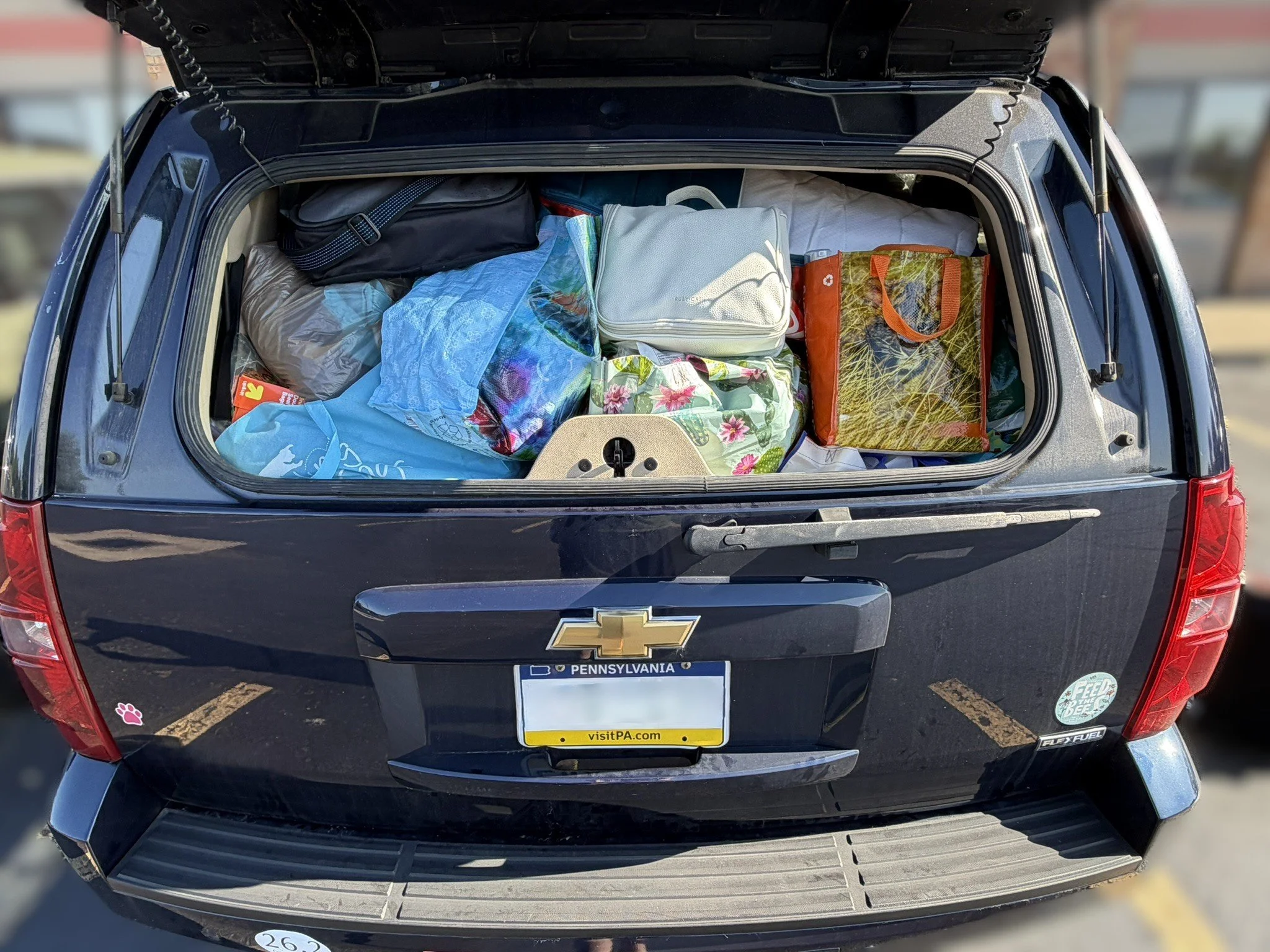
I glance at the piles still filling the living room. I had analyzed our accumulations, sorting each into its proper place: suitcase, storage, sell, donation, or trash. My red-blooded, true patriotic, God-blessed American side had calculated fair-market value and judge the opportunity cost of selling it against time lost on packing while listing and coordinating with buyers, expending anything that didn’t surpass an efficiency threshold, aided by Artificial Intelligence. My blue-blooded American side paused, thinking of adding to landfills, already overflowing, already disrupting wildlife, and on top adding usable stuff. My heart had clinched recalling the time my wife gave me this one thing, Christmas of 2011. But having visited Olduvai Gorge, I imagine Grog packing now for me, being an experienced nomad himself. How would that go?
He immediately rifles through my carefully segmented boxes, casting things aimlessly every which way. I hear crashes and clanks and thuds. Naturally, Grog doesn’t appreciate that particular Star Wars set was a special edition, that certain picture was custom framed, or that he just shredded my wedding album. In Olduvai Gorge, he carried the hand axe, but little else, so says the book. He needed the axe, little else. Some say the communication around that campfire compelled his evolution, mentally, physically, emotionally and spiritually, made him human.
So, all you need is love? It’s a nice sentiment, especially at the outset of my adventure. But truth be told, this purging burns. Perhaps American materialism is too ingrained in me. Perhaps I enjoy comforts too much. In part, waste feels senseless. But ultimately, I recalled something a friend once told me, speaking of his hunting gear, “Money doesn’t buy happiness, but it does buy the things that make me happy.” For him to pitch his bow might be like a painter squeezing full tubes of burnt umber down the sink, or a musician smashing his only instrument. Traumatic. Painful. So, our stuff expresses our identity. And as soon as early humans began painting on walls, I believe that some humans also carried pigments with their axes, filling a personal need beyond the base biological need. Fortunately for me, I can fit my “pigments” in a suitcase, featuring wheels, which roll while I sprint to a connecting flight, nary a hungry lion in sight. So long, to all the rest.
For more on human history check out A History of the World in 100 Objects by Neil MacGregor.